
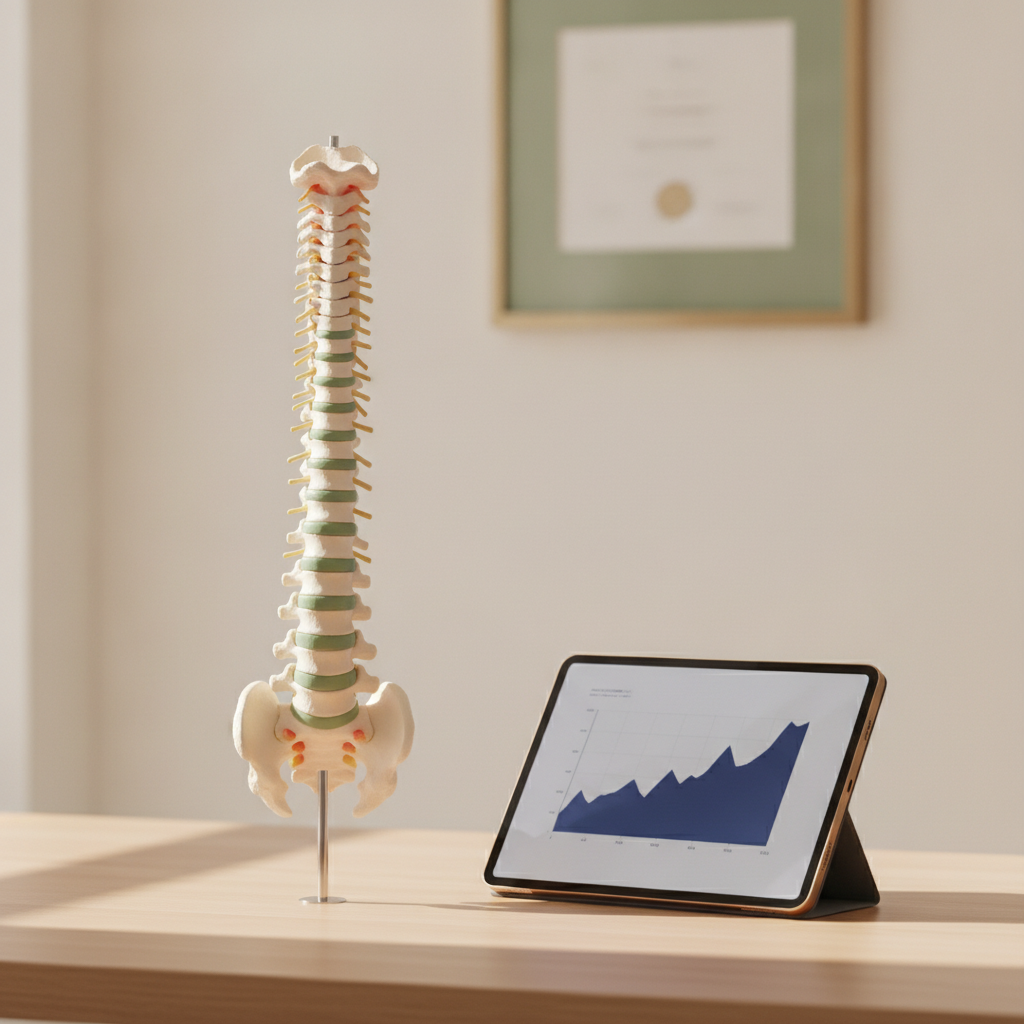
You don't have only one option for back pain
Back pain is the reason millions of people get sent to physical therapy — and for many it helps. But if PT isn't accessible, isn't working, or isn't something you want to keep paying for visit after visit, it's worth knowing that the leading clinical guidelines actually endorse a range of approaches, not just one.
This is general information, not medical advice. Before trying any alternative, rule out the serious stuff: if your back pain comes with leg numbness or weakness, loss of bladder or bowel control, fever, or followed a fall or accident, see a physician now. Those are red flags, not "tough it out" situations.
With that said — here's what the evidence supports for ordinary, non-emergency chronic low back pain.
What the clinical guideline says (this is the important part)
The single most useful fact for anyone with chronic low back pain: the American College of Physicians, in its clinical practice guideline, recommends that patients and clinicians start with non-pharmacologic treatment — that is, non-drug approaches — before medication.
The options it names as first-line include exercise, multidisciplinary rehabilitation, acupuncture, mindfulness-based stress reduction, tai chi, yoga, motor-control exercise, progressive relaxation, biofeedback, low-level laser therapy, cognitive behavioral therapy, and spinal manipulation. The guideline's reasoning is that these carry fewer harms than drugs.
Read that list again, because it reframes the whole question. "Alternatives to physical therapy" aren't fringe — several of them sit in the same guideline-recommended tier as PT itself.
The strongest evidence-backed alternatives, in plain terms
Yoga therapy
Yoga appears by name in the ACP's first-line list for chronic low back pain. The key distinction: this means structured, supervised yoga, not a random drop-in class. Yoga therapy is a one-on-one practice built around your specific back by a clinically trained therapist — they adapt poses to your limitations, watch your form, and progress you over time. That supervision is what turns it from exercise into an intervention.
It suits people with chronic, non-acute low back pain who want to build the strength, mobility, and body awareness that may help reduce flare-ups, and those who'd rather avoid or reduce pain medication.
Supervised exercise and movement coaching
Progressive, guided exercise is the backbone of recovery for most mechanical back pain. A qualified movement or corrective-exercise coach delivers the same core ingredients as PT — loading, form, progression, accountability — often at a lower per-session cost. The limit: a coach can't diagnose, so this is for known, non-complex back pain.
Acupuncture and spinal manipulation
Both appear in the guideline conversation and can provide meaningful short-term relief. Most people get the most from them when they're paired with an active practice that builds strength, rather than used alone.
Mind-body approaches (MBSR, tai chi, progressive relaxation)
Chronic back pain has a real stress-and-nervous-system component, and these approaches — also first-line in the ACP list — target exactly that. They tend to work best as a complement to physical work, not a full replacement. If stress is the dominant driver, a somatic therapy approach may fit even better.
How to choose without guessing
A simple way to sort it: if you want to build durable strength and prevent recurrence, lead with a supervised active practice — yoga therapy or movement coaching. If you want short-term relief while you build that base, add a passive therapy like acupuncture or manual work. If stress and tension are clearly feeding the pain, weave in a mind-body or somatic practice.
What you don't want is the thing most people default to: a few PT visits, a printout of exercises, and then nothing — at which point the pain quietly returns. The maintenance practice is the part that lasts.
What it costs — and why the math favors alternatives
Physical therapy runs $100–$250 per session without insurance, or a $20–$75 copay with coverage until you hit a deductible. Across a full course, that adds up fast.
A supervised yoga therapy practice can be more cost-predictable, and in the U.S. it may be HSA/FSA-reimbursable with a Letter of Medical Necessity when a provider prescribes it for your diagnosed back condition. For the full coverage breakdown, see does insurance cover yoga therapy, and for a side-by-side, yoga therapy vs physical therapy cost.
For benefits and clinical teams: chronic low back pain is one of the most expensive line items in any health plan. A guideline-recommended, lower-cost active practice that reduces visits and medication is a cost-containment story, not a wellness perk. My Yoga Network designs back-pain programs that report measurable outcomes. Ask about a measurable program →
The bottom line
For ordinary chronic low back pain, you have several guideline-backed alternatives to physical therapy — and supervised yoga therapy is one of the best-supported. Match the approach to your goal, rule out red flags first, and prioritize a practice you can sustain — that ongoing practice is what helps keep back pain from returning.
Find a clinically trained yoga therapist who works with back pain → Get matched